

A production linefor AI agents.
Any team can have an agent running by tonight. That’s the pilot. Production is the hard part: what it’s allowed to do, how you prove it behaves, who’s watching it, and who signed for it. Omnia is the production line that answers all four, for every agent you run, whatever stack it’s on.
Your teams keep the stacks they’ve chosen.
Free while you build. Free to run. Enterprise features when you need them.
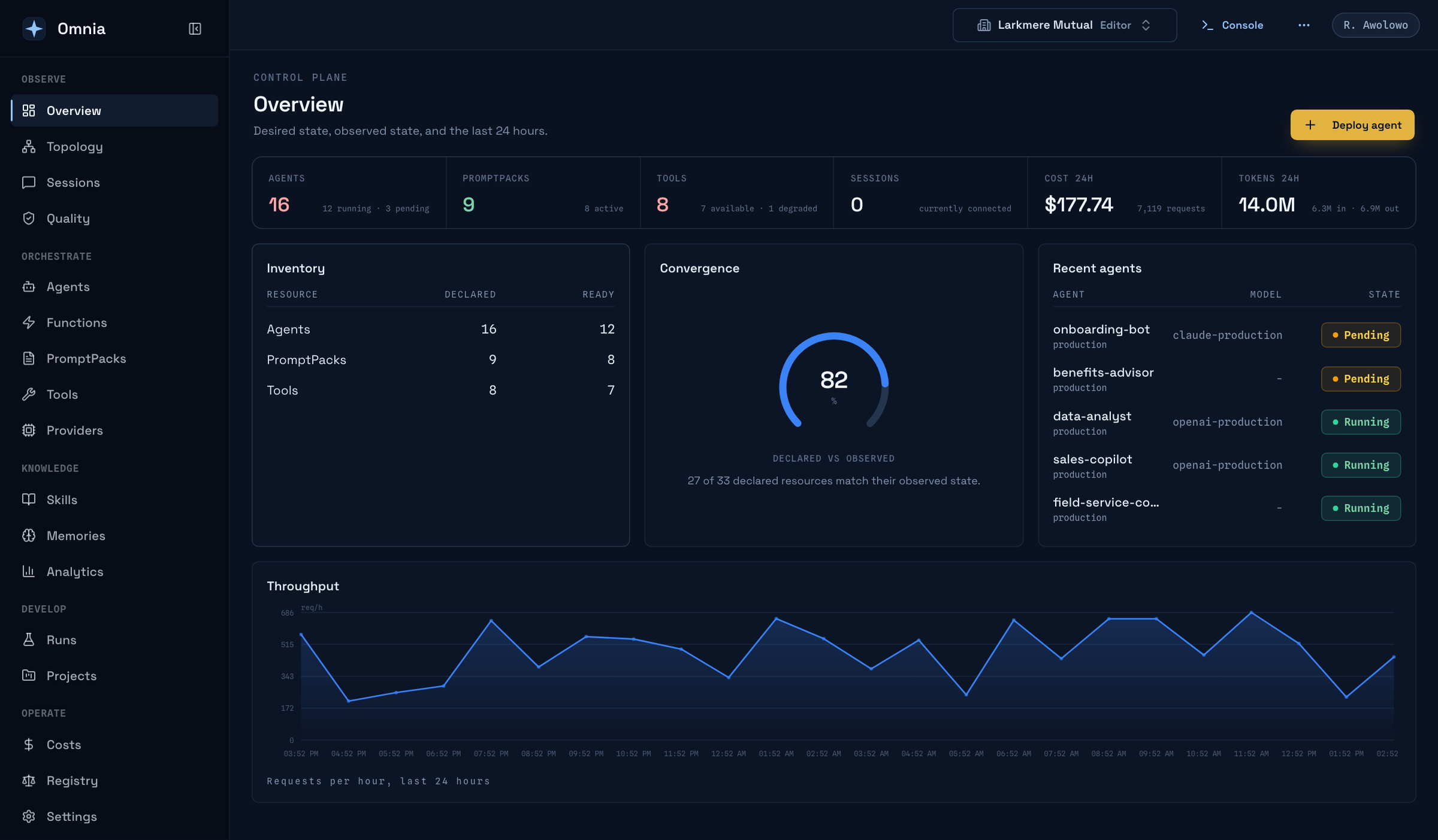
omnia · your cluster · 16 agents · 27 of 33 converged
An invoice queue, a claims backlog, a customer on the phone. One plane over all of it.
A production line does the same five things, whatever’s on it.
Nobody’s doing it wrong. Buy a machine and you get a machine. The machines will be different next year. The line is the business.
What it is. What it may do. How you know it’s behaving. One definition, versioned.
Before it goes live, and every day after. You can’t read an agent and know what it’ll do. You run it, and you check.
Every call, every tool, one place. Whatever stack it’s on.
What it can touch. What it can send. Who signed for it.
When a supervisor asks what happened, the answer’s already written.
Everything you build here, you can take away.
Every quarter brings a new set of tools and a new integration layer to write for them. The usual alternative is one vendor who takes the sprawl away and takes your data with it.
This runs in your own infrastructure, and the foundations under it are open. The definitions you write, the tests that prove them and the runtime they execute on are yours to keep.
Omnia is the one part you can’t read the source of. It runs in your cluster, and nothing leaves it. The licenceslicenses, in full →
What you approved is what’s running.
One versioned artefactartifact: the tools it may call, the models it was tested against, the steps it follows, the checks it has to pass. The agent can’t step outside it, and those checks keep running against the real work.
The seven stages run as a cycle: ideate, then define and test against each other until the agent holds, then the pack compiles, then the deploy gate, then the runtime, then live evaluation, whose failures come back as regression cases at define ⇆ test, and it starts again.
What you’ll want answered before you install anything.
An agent there can be callable, scheduled, conversational or voice, all off one definition.
Your cluster, AgentCore, Vertex Agents or Foundry, with one console answering for all four.
Checked against the identity of the person who asked, on what the agent reads and what it sends.
Redacted before the model, before the recording, and again before memory.
What the business knows, what the agent learned, and what belongs to one person.
The same cases, run again against every model you allow, on a schedule.
The user side is simulated too, so every run is a different conversation. Load-test it, evaluate it, or keep what passed.
“Every team is building agents differently, and it’s going to become a mess.”
If that’s a sentence you’ve said out loud this quarter, we’d like to hear the rest of it. We work with one or two teams at a time, you talk to the people building the platform rather than to an account manager, and a partner’s terms hold through general availability. Bring the estate you already have. The first conversation is worth having before any of it moves.
Every feature, in your own cluster, in ten minutes.
No cluster? Start with PromptArena, the open-source tester →