

Build on it and never pay us anything.
The spec, the testing and the runtime are open, and free in production as well as in dev. Build an agent on them and run it at whatever scale you like.
 PromptPack MIT The spec for what an agent is: its prompts, tools, steps, the models it requires and the tests it has to pass. Twelve accepted RFCs, and a schema you can validate against before you trust anyone’s claim about it.
  PromptArena Apache 2.0 Puts the awkward cases through an agent’s real tools, including callers who talk over it, and scores whether it held the line. Point it at whatever you’ve already built. No keys, runs in your CI.
  PromptKit Apache 2.0 The runtime the packs run on: text, voice and video, tools, memory and workflow state in one Go binary. Free in production too.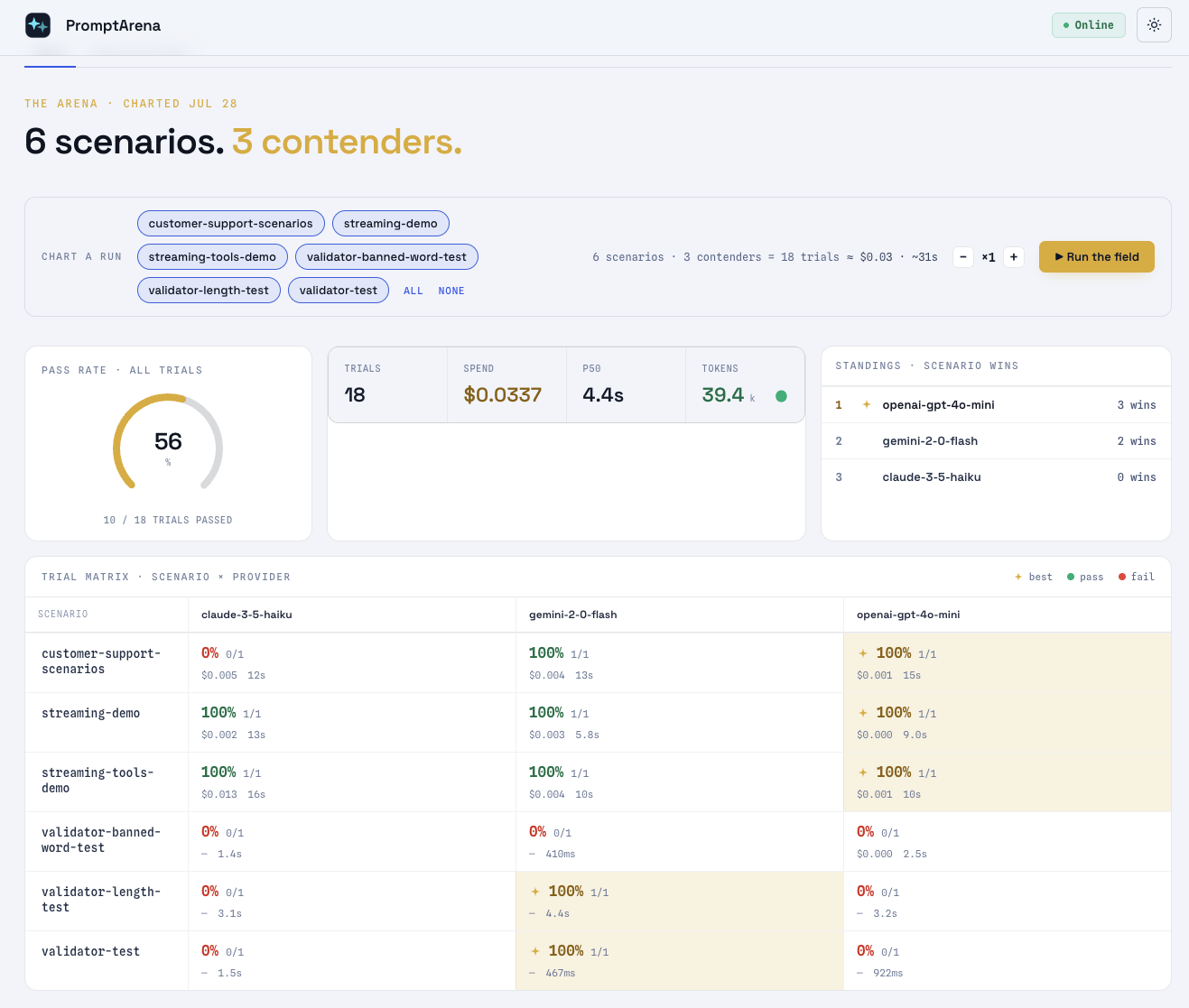
Nine times the throughput, a quarter of the memory.
At two thousand concurrent streams PromptKit holds 2,740 requests a second with zero errors, and first-byte latency is flat all the way from a hundred. The framework in second place manages 299.
The memory numbers matter more, because RAM is what your instance size is priced on: 514 MB under load, against 2.2 GB and 8.9 GB for the alternatives. Fewer pods and smaller nodes for the same traffic.
Measured on a published tool-calling profile against a shared mock upstream. The harness is in the repo, make round1-tools, so you can disagree with us in your own numbers.
linux/arm64 · 14 cores · round1 tool-calling profile · 0 errors against LangChain’s 18,265
Four deployers, one interface, all public.
Four public repos behind one public interface, so the same definition reaches your own cluster or any of the three hyperscaler runtimes. A fifth is yours to write.
And the part that isn’t open.
Omnia is the one thing here you can’t read the source of. Every feature is yours in your own cluster while you build, for as long as you want, for nothing. And it keeps running when you put it in front of real traffic.
Free while you build. Free to run. Enterprise features when you need them.
Where the line falls.
Run agents free. Pay for assurance, compliance and scale. Omnia without a licencelicense doesn’t nag you or stop: it runs the left column, in production, for good.
- Agents in production. The runtime, sessions, telemetry and the console: as many agents as you like, carrying real traffic.
- Tool access control. Which tools an agent is allowed to call at all, enforced at the mesh.
- Test projects from git. Up to ten scenarios on one worker, wired into the CI you already run.
- Every deploy target. Your cluster, AgentCore, Vertex Agents or Foundry. The deployers are open source.
- Testing at volume. Load runs, data generation, cron schedules, many workers, and sources from OCI or S3.
- Memory. The four tiers and the rule about which wins, the galaxy, analytics and consolidation.
- Privacy and compliance. Redaction at every surface, consent, erasure, and the audit hub behind it.
- Policy on the arguments. Rules that read what an agent is about to send, not only which tool it called.
- Your own front end. Custom facades, and the console rebranded when it goes in front of someone else’s team. Nothing below the console is rebranded.
The free tier caps test runs at ten scenarios and one worker. That’s enough to wire the checks into CI and watch them fail; it isn’t enough to prove a process at volume, and we’d rather you read that here than find it out later.
The right column has a price, per production environment, per year. The tiers →